Small unmanned aerial systems (sUAS) have fundamentally changed the threat landscape across defense and critical infrastructure. Low-cost drones are now capable of surveillance, disruption, and coordinated attacks, often operating in environments where traditional defenses were never designed to respond.

Counter-UAS (C-UAS) systems are evolving quickly to address this challenge. Detection, tracking, and mitigation technologies continue to advance—but system performance ultimately depends on something less visible: the reliability of the interconnect systems that enable those technologies to function as a cohesive unit.

The core takeaway: counter-drone systems fail at the interfaces first. Interconnect design determines whether the system works when it matters.

The Shift in Drone Threat Complexity

Modern drone threats are not defined by a single platform, but by adaptability and scale.

Key characteristics

  • Low-cost, widely available platforms enabling rapid deployment
  • Swarm capability that stresses detection and response systems
  • Autonomous navigation reducing reliance on RF control links
  • Multi-mission payloads including ISR, electronic disruption, and kinetic impact

This has forced a transition from static perimeter defense to dynamic, layered countermeasures that operate continuously and in real time.

UAS Systems

What Counter-UAS Systems Must Deliver

C-UAS platforms integrate multiple subsystems, each dependent on uninterrupted electrical and signal performance.

Core system layers

  • Detection: radar, RF sensing, EO/IR systems
  • Identification: signal classification and threat validation
  • Tracking: continuous positional awareness and trajectory prediction
  • Mitigation: jamming, spoofing, or physical neutralization

These subsystems must operate simultaneously, exchanging high-speed data and maintaining stable RF performance under changing conditions.

Why Interconnect Systems Define Reliability

Most system failures in field-deployed C-UAS platforms do not originate in the sensors or processors—they occur at connection points.

Common failure modes

  • EMI leakage across connector interfaces
  • RF signal degradation due to impedance mismatch
  • Moisture ingress at cable transitions
  • Connector disengagement under vibration
  • Insulation breakdown in high-temperature zones

These issues are compounded in mobile deployments, outdoor environments, and electromagnetically dense operating conditions.

Counter-UAS Platforms

Core Interconnect Requirements for Counter-UAS Platforms

RF Signal Integrity

Detection and mitigation rely on consistent RF performance.

Design requirements include:

  • Controlled impedance throughout cable assemblies
  • Continuous shielding across connectors and enclosures
  • Low insertion loss and minimal signal distortion

High-performance connectors from manufacturers like Amphenol—including MIL-DTL-38999 Series III platforms, VITA connectors, and WaSP microminiature connectors—are commonly used in defense-grade systems. Performance, however, depends on how these components are integrated into the overall assembly.

Environmental Sealing and Protection

C-UAS systems are frequently deployed in harsh, exposed environments.

Required protections include:

  • IP/NEMA-rated sealing against moisture and contaminants
  • Resistance to dust, chemicals, and corrosion
  • Long-term durability under temperature extremes

Solutions such as overmolded cable assemblies eliminate ingress points by sealing critical transitions between cable and connector.

Power and Signal Integration

Modern systems require simultaneous transmission of multiple electrical functions:

  • High-current power for mitigation systems
  • High-speed data for sensing and analytics
  • RF signals for detection and countermeasures

This drives the need for hybrid cable assemblies, which consolidate multiple pathways into a single engineered solution, reducing size, weight, and failure points.

Mechanical Reliability Under Dynamic Conditions

Many C-UAS systems are mounted on vehicles or designed for rapid deployment, introducing continuous vibration and mechanical stress.

Failure risks include:

  • Conductor fatigue at termination points
  • Connector loosening over time
  • Abrasion and insulation wear

Integrated strain relief and routing strategies are essential. Solutions like molded breakout and strain relief systems help prevent localized stress failures.

EMI Shielding and Grounding Continuity

C-UAS systems operate in contested electromagnetic environments where both detection and mitigation generate interference.

Design priorities include:

  • Continuous shielding across all interconnect interfaces
  • Proper grounding across cables, connectors, and enclosures
  • Suppression of internal and external EMI sources

Technologies such as EMI shielding and metal braiding are critical—but only when implemented as part of a complete system design.

The Integration Gap

Many system-level failures can be traced back to fragmented design approaches:

  • Connectors selected independently of cable architecture
  • Materials added after initial design to solve sealing or EMI issues
  • Multiple vendors introducing tolerance mismatches
  • Lack of validation at the system level

This creates hidden vulnerabilities—particularly at transition points between components.

Proven Components

Integrating Proven Components into System-Level Solutions

High-performance components from suppliers such as Amphenol are widely used in defense systems. These components are engineered to meet demanding specifications such as MIL-DTL-38999 and MIL-PRF-2950.

XACT integrates these components into complete interconnect systems by combining:

  • Connector platforms from proven manufacturers
  • Application-specific cable design and routing
  • Environmental sealing and strain relief
  • System-level validation across electrical, mechanical, and environmental conditions

This includes:

FAQ: Testing and Reliability at XACT EMS

Defense-grade systems often use MIL-DTL-38999 Series III connectors, VITA connectors for modular architectures, and WaSP microminiature connectors for space-constrained designs. These connector platforms are selected for their durability, environmental sealing, and consistent electrical performance in harsh operating conditions.

Counter-UAS platforms operate in dense electromagnetic environments where detection and jamming occur simultaneously. Without proper shielding and grounding continuity, interference can degrade signal integrity, reduce detection accuracy, and limit mitigation effectiveness.

MIL-DTL-38999 is a military specification for circular connectors designed for harsh environments. Series III connectors are commonly used in defense systems due to their high vibration resistance, secure coupling mechanisms, and ability to maintain performance in extreme conditions.

Fiber optic connectors, often specified under MIL-PRF-2950, are used in systems requiring high-speed data transmission and immunity to electromagnetic interference. While XACT does not manufacture fiber optic cables, these connectors are often integrated into broader system architectures alongside copper-based cable assemblies.

Hybrid cable assemblies combine power, signal, and RF transmission into a single integrated solution. This reduces system complexity, simplifies routing, and minimizes potential failure points.

Overmolding encapsulates the transition between cable and connector, providing environmental sealing, strain relief, and mechanical protection. This is critical in applications exposed to moisture, vibration, and temperature extremes.

System Reliability Starts at the Interface

Counter-UAS systems are only as effective as their weakest connection point.

As drone threats continue to evolve, performance requirements will increase—not just in detection capability, but in reliability under real-world conditions. Systems must operate continuously without failure at critical moments.

That requires interconnect systems engineered from the start as part of the overall design—not added after the fact.

Engineering a Hermetic, Pressure-Rated Cable Assembly for Subsea Weld Inspection Probes

XACT engineered a fully hermetic, pressure-rated cable assembly for a subsea weld inspection probe used in harsh industrial and offshore environments. The redesigned interconnect system was developed to eliminate water ingress risk, withstand significant hydrostatic pressure, and preserve signal stability for a precision electromagnetic inspection platform.

The project required non-standard encapsulation methods and iterative engineering refinement before achieving a validated production-ready design.

Program Overview

A manufacturer of advanced non-destructive testing (NDT) instrumentation required a ruggedized cable assembly for a diver-operated weld inspection probe deployed underwater.

The probe is designed to inspect surface-breaking cracks within ground welds on submerged structures. Because inspection accuracy depends on stable electromagnetic measurements, the cable assembly must maintain consistent electrical performance while operating under pressure and exposure to moisture.

The engagement was executed through our Engineering Design Services team, combining interconnect design, encapsulation process development, and material optimization.

The assembly required:

  • Full hermetic sealing
  • Resistance to hydrostatic pressure equivalent to approximately 900 meters
  • Mechanical durability under handling and bending
  • Stable signal transmission for EMI-sensitive measurements

The Challenge

Traditional thermoplastic overmolded designs were evaluated but did not meet environmental performance targets for subsea deployment.

Primary risks included:

  • Hydrostatic compression creating micro-leak pathways
  • Voids within molded transitions
  • Adhesion failure between cable jacket and encapsulation material
  • Moisture ingress impacting signal amplitude and measurement accuracy
  • Mechanical stress concentration at the cable-to-probe interface

In this application, even minor moisture intrusion can cause signal drift or inconsistent readings. The interconnect needed to function as a structural and environmental barrier — not simply a termination.

The Engineering Solution

XACT developed a custom epoxy-potted cable assembly using a specialized potting and application process in place of conventional molded materials.

The redesigned termination incorporated:

  • Custom mold tooling for controlled encapsulation geometry
  • Full epoxy potting to eliminate void formation
  • Material selection optimized for compressive strength and adhesion
  • Controlled cure methodology to reduce internal stress
  • Iterative prototyping and refinement prior to final validation

This solution builds upon XACT’s expertise in Overmolded Cable Assemblies and advanced encapsulation strategies used in Rugged and Harsh Environment Assembly Solutions.

Where signal-sensitive systems require additional shielding reinforcement, integrated EMI and Metal Braiding Solutions can be incorporated to preserve electrical stability in high-interference environments.

The final design created a structurally reinforced, fully encapsulated termination capable of resisting hydrostatic compression while preventing moisture-driven degradation.

Validation

The completed cable assembly was pressure tested to simulate hydrostatic conditions equivalent to approximately 900 meters of depth.

The assembly successfully passed validation without leakage or structural compromise.

Following evaluation, the customer approved the initial production configuration and indicated that additional probe variants may be developed using the validated architecture.

System-Level Reliability Considerations

Subsea inspection systems require coordinated control of sealing, shielding, mechanical strain relief, and thermal stability.

Where enclosure-level environmental sealing is required, precision shielded gasket solutions or dispensed form-in-place gaskets can be integrated at housing interfaces to maintain environmental protection and EMI continuity.

If internal electronics generate heat within sealed housings, engineered thermal management solutions can be applied to stabilize operating temperatures and reduce long-term drift.

Where broader electromagnetic control is required, coordinated EMI shielding solutions may be incorporated at the system level.

Through an integrated materials and interconnect strategy, environmental protection, electrical performance, and mechanical durability are engineered together rather than addressed independently.

Results

  • Successful hydrostatic pressure validation
  • Hermetic sealing achieved
  • Improved mechanical reinforcement at termination
  • Reduced risk of moisture-driven signal instability
  • Platform architecture supporting future probe variants

Rail platforms are designed for 30–40 years of service life.

Your cable assemblies are expected to survive every one of them.

Between high-vibration undercarriage routing, washdown exposure, traction power EMI, thermal cycling, and repeated maintenance handling, rail interconnect systems operate in conditions far more severe than most industrial environments. Yet once qualified, they are often locked into a platform for decades.

When harness failures occur, they rarely fail in isolation. They trigger troubleshooting cycles, service disruptions, parts obsolescence challenges, and—in signaling applications—potential safety exposure. In rolling stock programs, redesigning or requalifying an interconnect after platform release can be significantly more disruptive and expensive than engineering it correctly upfront.

For rail OEMs, signaling integrators, and depot MRO teams, reliability is not about selecting a “tough cable.” It is about engineering a custom cable assembly system that accounts for vibration, ingress, EMI, routing constraints, serviceability, and long-term configuration control from day one.

The most common rail interconnect failures are predictable. And when addressed at the design stage, they can be engineered out before they ever reach the field.

The 6 Most Common Rail Cable Assembly Failure Modes — and How to Engineer Them Out

1. Vibration Fatigue at Connector Transitions

The Problem

Rail vehicles and wayside systems experience:

  • Continuous vibration
  • Shock loading
  • Micro-movement at clamp points
  • High-frequency harmonics from traction systems

Failure typically initiates at:

  • Connector backshell exits
  • Strain relief transitions
  • Harness branch points
  • Rigid-to-flex transitions

Intermittent faults are often the first symptom—making diagnosis costly and time-consuming.

Engineering Solutions

  • Purpose-built strain relief geometry
  • Targeted overmolding at high-stress transitions
  • Branch design optimized for real routing constraints
  • Controlled termination processes to ensure repeatability
  • Mechanical support strategy integrated into harness design

Overmolding is particularly effective when engineered for stress distribution rather than cosmetic sealing.

Learn more about engineered transition protection in our Overmolded Cable Assemblies solutions.

2. Moisture Ingress and Connector Corrosion

The Problem

Rail systems are exposed to:

  • Washdown procedures
  • Outdoor weather
  • Condensation cycles
  • Road debris and splash zones

Ingress failures often originate not at the connector face, but at:

  • Cable-to-connector interfaces
  • Inadequate backshell sealing
  • Improper grommet sizing
  • Inconsistent assembly torque or potting

Engineering Solutions

  • Sealing the entire interface system—not just the connector
  • Booted or overmolded transition zones
  • Environmental validation aligned with real deployment conditions
  • Defined assembly controls for repeatability

For harsh-environment rail builds, see: Rugged and Harsh Environment Assembly Solutions.

3. Abrasion in Undercarriage and Wayside Routing

The Problem

Abrasion damage rarely occurs randomly. It is usually traceable to:

  • Frame pass-through points
  • Clamp edges
  • Vibration-driven rubbing
  • Maintenance handling

Over time, jacket wear exposes shielding and conductors.

Engineering Solutions

  • Abrasion-resistant sleeving in known contact zones
  • Strain brackets and routing control strategies
  • Protective transitions at bulkheads
  • Serviceability-focused harness layout

Protective sleeving and tubing options can be integrated directly into build specifications.

4. EMI and Signal Integrity Failures in Train Control Systems

The Problem

PTC, CBTC, TCMS, and signaling systems operate in high-EMI environments due to:

  • Traction power systems
  • High-current switching
  • Nearby RF communication equipment

Improper shielding termination or inconsistent grounding strategies can result in:

  • Data corruption
  • False fault indications
  • Reduced system reliability

Engineering Solutions

  • Defined shield termination architecture
  • Controlled 360° shield bonding where required
  • Ground strategy aligned to system integrator specifications
  • Low-noise cable assemblies built for signal integrity

See our experience in signal-focused builds within the Communications & Telecom Sector

5. Thermal Degradation at High-Current Interfaces

The Problem

High-current traction and auxiliary power systems generate localized heat at:

  • Crimp interfaces
  • Terminal blocks
  • Connector contacts

Improper termination or underspecified conductors can accelerate insulation breakdown and reduce service life.

Engineering Solutions

  • Correct conductor sizing for duty cycle
  • Crimp validation and pull-test documentation
  • Thermal-aware routing inside enclosures
  • High-current rated connectors and assemblies

XACT supports high-current and mixed power/signal harness builds through our Custom Cable Assemblies program.

6. Documentation and Configuration Drift Over Long Service Life

The Problem

Rail platforms evolve over decades. Without disciplined configuration control:

  • Harness revisions drift
  • Replacement builds mismatch
  • Labeling inconsistencies create service errors
  • Obsolescence introduces undocumented substitutions

This is one of the most common causes of depot frustration.

Engineering Solutions

  • Controlled drawings and revision management
  • Traceable build documentation
  • Test records retained for lifecycle support
  • Kitting strategies for MRO programs

For lifecycle extension and rebuild programs, explore: Cable Repair & Recertification

Rail-Specific Compliance Considerations

Depending on application lane, rail interconnect programs may require:

  • EN 45545 fire/smoke compliance (rolling stock)
  • AAR standards (freight)
  • Documented EMI/EMC awareness
  • Ingress protection validation
  • Long-term traceability and configuration discipline

Engineering for compliance must begin at the design stage—not after platform qualification.

Designing for the Rail Lifecycle

Rail interconnect reliability is not about preventing “cable damage.”

It is about designing:

  • For 30–40 year service life
  • For depot-level serviceability
  • For configuration control across program revisions
  • For environmental realities—not lab assumptions

The difference between commodity cable supply and engineered rail harness systems is lifecycle thinking.

When vibration, EMI, moisture, and thermal loads are accounted for at the architecture stage, failure rates drop, troubleshooting cycles shorten, and MRO operations stabilize.

Rail platforms reward disciplined engineering.

They punish shortcuts.

Ready to engineer failure-resistant cable assemblies for your rail platform?

Talk to XACT’s engineering team about custom harness design, rugged overmolding, high-current builds, and long-term MRO support.

Surface and underground mining operations may extract similar materials, but the electrical environments they create are fundamentally different. From regulatory requirements to mechanical stress profiles, interconnect systems must be engineered differently depending on where they operate.

Designing cable assemblies, harnesses, and terminations without accounting for these differences increases the risk of premature failure, MSHA citations, and avoidable downtime. The most reliable mining programs treat surface and underground interconnect systems as distinct engineering challenges—each with its own compliance framework, environmental exposures, and dominant failure modes.

Regulatory Differences: Coal vs Metal/Nonmetal, Surface vs Underground

Electrical compliance in mining is governed primarily by the Mine Safety and Health Administration (MSHA). Requirements differ based on mine type and location.

Underground Coal Mines (30 CFR Part 75)

Underground coal operations face:

  • Strict flame-resistance requirements
  • Emphasis on trailing cable protection
  • Increased scrutiny on permissibility and ignition risk
  • Higher inspection sensitivity to damaged insulation or splices

Fire propagation risk in confined environments drives many of these requirements. Cable systems must limit flame spread and maintain grounding integrity under wet, abrasive conditions.

Surface Coal Mines (30 CFR Part 77)

Surface coal operations focus on:

  • Protection against physical damage
  • Grounding and bonding integrity
  • Guarding of energized conductors
  • Safe temporary power installations

Flame spread remains important, but open-air conditions reduce confinement risk.

Metal and Nonmetal Mines (30 CFR Parts 56 and 57)

Metal and nonmetal operations emphasize:

  • Protection from mechanical damage
  • Proper insulation and guarding
  • Ground-fault protection
  • Maintenance of wiring in crushers, conveyors, and process plants

The regulatory framework alone justifies differentiated interconnect strategies between underground and surface environments.

Mechanical Stress Profiles: Confined Flex vs Open-Site Impact

Underground Mining: High Flex + High Moisture

Underground interconnect systems are exposed to:

  • Continuous flexing in trailing cables
  • Sharp bend radii in confined routing paths
  • Constant moisture and water ingress risk
  • Rock abrasion and falling debris
  • Frequent machine movement and cable dragging

Common underground equipment includes:

  • Continuous miners
  • Shuttle cars
  • Load-haul-dump (LHD) vehicles
  • Bolters and drills

Trailing cables and high-flex harnessing are dominant architectures. Mechanical fatigue at termination points is one of the most frequent failure sources.

Engineering controls typically include:

  • High-strand-count conductors for flex endurance
  • Molded strain relief to prevent conductor breakage
  • Abrasion-resistant jacketing
  • Sealed or overmolded transitions at connectors

For assemblies designed specifically for these environments, see:

Rugged and Harsh Environment Assembly Solutions

Surface Mining: Impact, UV, and Vehicle Interaction

Surface mining introduces different mechanical risks:

  • UV degradation
  • Freeze-thaw cycling
  • Long cable runs exposed to vehicle traffic
  • Crushing risk from haul trucks and loaders
  • Steel structure abrasion
  • Dust contamination

Cable runs are often longer and more semi-permanent. While flex demands may be lower than underground trailing cables, exposure to environmental degradation is significantly higher.

Surface design priorities often include:

  • UV-resistant jacket materials
  • Crush protection or armored routing
  • Controlled strain relief at panel and junction transitions
  • Protective tubing and sleeving

Protective options include:

Tubing & Sleeving Solutions

Electrical Risk Differences

Underground Electrical Risk Profile

  • High humidity increases leakage current risk
  • Ground-fault sensitivity is critical
  • Flame propagation risk in confined airspace
  • Greater inspection scrutiny on damaged insulation

Failure of grounding continuity is especially serious underground. Proper termination practices and robust connector systems are essential.

Where high-current power interfaces are involved, properly engineered terminations and sealed strain relief are critical.

See: Overmolded Cable Assemblies

Surface Electrical Risk Profile

  • Voltage drop concerns over long distribution runs
  • Environmental degradation of insulation
  • Contamination of connectors from dust and mud
  • Intermittent grounding failures due to corrosion

Surface systems often incorporate larger distribution assemblies, portable substations, and panelized power systems.Termination integrity and environmental sealing remain critical but are stressed differently than underground.

Dominant Failure Modes by Environment

Environment Most Common Failure Drivers Typical Root Cause
Underground Conductor fatigue Repeated flex at machine interface
Underground Jacket breach Dragging on rock or steel edges
Underground Moisture ingress Inadequate sealing at terminations
Surface UV cracking Prolonged sunlight exposure
Surface Crushing damage Vehicle traffic over cable runs
Surface Connector contamination Dust and mud ingress

Recognizing these patterns allows interconnect systems to be engineered proactively rather than reactively.

Architecture Differences: Trailing Cable vs Distributed Assemblies

Underground Architecture

  • High-flex trailing cable systems
  • Frequent disconnect/reconnect cycles
  • Compact routing through confined machine frames
  • Greater reliance on molded breakouts and sealed interfaces

Hybrid power + control harnessing is common in mobile underground equipment.

See: Hybrid Cable Solutions

Surface Architecture

  • Longer, semi-permanent runs
  • Panel-to-equipment distribution
  • Greater emphasis on modular skids and junction boxes
  • Lower flex frequency but higher exposure risk

Surface processing plants introduce additional fixed harness and panel wiring assemblies.

Compliance Is a Lifecycle Issue, Not an Installation Event

Both surface and underground environments share one reality:

Electrical systems that are compliant on day one can become non-compliant through wear, damage, or field modification.

Effective compliance strategy includes:

  • Inspection intervals matched to environment severity
  • Controlled repair procedures
  • Documented rebuild and recertification programs
  • Traceable harness assemblies built to defined workmanship standards

For lifecycle support:

Cable Repair & Recertification

Engineering Implications for Mining Interconnect Design

Designing the same cable assembly for both surface and underground use without modification introduces unnecessary risk.

Instead, specification should consider:

  • Flex cycle requirements
  • Flame-resistance expectations
  • Environmental exposure (UV vs moisture dominance)
  • Routing method (dragging vs fixed support)
  • Inspection cadence
  • Termination access and strain relief design

When these variables are defined early, interconnect systems become predictable and durable rather than reactive maintenance items.

For full custom interconnect development:

Custom Cable Assemblies

Engineering the Right Interconnect for the Right Mine

Surface and underground mining may operate under the same regulatory umbrella, but they impose fundamentally different electrical and mechanical demands. The most reliable programs treat these environments separately during specification, validation, and maintenance planning.

Engineering cable assemblies to match real environmental stress—rather than defaulting to generic “mining-rated” solutions—reduces citation risk, improves uptime, and extends service life across the fleet.

Wind turbines operate under constant mechanical stress. Inside the tower and nacelle, cable systems are exposed to vibration, torsional movement, temperature cycling, moisture, oils, and tight routing constraints. When interconnect systems fail, the result is downtime, costly mobilization, and extended troubleshooting cycles.

Reliable turbine performance starts with cable assemblies engineered specifically for motion, environmental exposure, and long-term serviceability.

Below are practical best practices for OEMs and service teams focused on improving reliability and reducing lifecycle cost.

Design for Motion: Vibration, Flexing & Rotation

Wind turbines are dynamic systems. Yaw rotation, pitch adjustments, and nacelle vibration all place continuous strain on cable assemblies.

Assemblies designed for static environments will fail prematurely in rotating systems.

Best practices:

  • Engineer for torsional stress in yaw loops
  • Maintain proper bend radius under continuous flex
  • Reinforce connector transitions with strain relief
  • Select jacket materials suited to UV, cold temperatures, and chemical exposure
  • Avoid compression damage from rigid mounting methods

XACT manufactures overmolded cable assemblies that reinforce connector transitions, improve environmental sealing, and extend service life in high-vibration applications.

Learn more about Overmolded Cable Assemblies

For extreme-duty applications:

Explore Rugged & Harsh Environment Cable Assemblies

Route Cables Strategically Around Turbine Components

Routing directly impacts durability. Poor routing increases abrasion, compression stress, and thermal exposure.

Standardizing routing design reduces variability between builds and simplifies field service.

Smart routing guidelines:

  • Avoid sharp edges and abrasion points
  • Use cushioned clamps without over-tightening
  • Maintain clearance from moving mechanical systems
  • Keep assemblies away from high-heat components
  • Design routing paths consistently across turbine platforms

For multi-branch harness distribution, molded breakouts provide organization and improved strain control.

View Molded Breakout & Splitter Solutions

Reduce Tower Time with Field-Ready Assemblies

Every hour inside a turbine increases operational cost. Serviceability must be considered during design, not after deployment.

Service-focused strategies:

  • Use pre-terminated harness assemblies
  • Standardize modular replacement kits
  • Minimize field termination requirements
  • Incorporate clear identification for fast troubleshooting
  • Design assemblies for glove-friendly handling

When refurbishing or extending the life of existing assemblies is more practical than replacement, XACT supports repair and recertification programs.

Cable Repair & Recertification Services

Protect Against Environmental Exposure

Wind installations encounter:

  • Extreme cold and heat cycling
  • Moisture and condensation
  • Salt exposure in coastal sites
  • Dust and particulate contamination
  • Oil and chemical exposure inside nacelles

Environmental sealing and mechanical protection are essential for maintaining signal integrity and power reliability.

Protective enhancements may include:

  • Environmental overmolding at transition points
  • Heat shrink tubing for insulation and strain relief
  • PTFE tubing for chemical and temperature resistance
  • Abrasion-resistant sleeving in high-contact zones

Heat Shrink Tubing Solutions

PTFE Tubing Solutions

Tubing & Sleeving Solutions

Maintain Signal Integrity in High-Power Environments

Wind turbines combine high-power systems with sensitive control and communication networks. EMI, contamination, and mechanical degradation can lead to intermittent faults and unexpected shutdowns.

Shielding, braiding, and reinforced terminations help preserve signal performance in electrically noisy environments.

EMI & Metal Braiding Solutions

Engineer for Lifecycle Reliability

Effective cable management extends beyond initial installation. Long-term performance depends on documentation control, manufacturing consistency, and supply chain stability.

XACT supports energy OEMs with:

  • Custom cable assemblies built to specification
  • Integrated electromechanical builds
  • Engineering design collaboration
  • Controlled manufacturing processes
  • Program-level supply chain support

Engineering Design Services

Energy Sector Solutions

Wind turbine uptime depends heavily on the integrity of its interconnect systems. Designing for motion, protecting against environmental hazards, standardizing routing, and simplifying field service significantly reduces failure risk.

Whether supporting new turbine platforms or upgrading existing fleets, engineered cable assemblies built for harsh wind environments deliver measurable improvements in reliability and service efficiency.

As electronic systems become more compact, intelligent, and performance-driven, engineers face growing pressure to reduce wiring complexity without sacrificing reliability. Hybrid cable assemblies solve this challenge by combining multiple electrical functions—such as power, data, Ethernet, RF, and control signals—into a single, engineered cable.

XACT Engineered Manufacturing Solutions designs and manufactures custom hybrid cable assemblies that help OEMs simplify system architecture, improve durability, and reduce installation costs—especially in harsh and mission-critical environments.

What Is a Hybrid Cable Assembly?

A hybrid cable assembly integrates two or more transmission types into a single cable jacket. Instead of routing multiple individual cables, engineers deploy one consolidated solution that is purpose-built for their application.

At XACT, hybrid cable assemblies commonly combine:

  • Power conductors
  • Ethernet or data lines
  • RF / coaxial cables
  • Control and sensor wiring

Why Engineers Choose Hybrid Cable Assemblies

Hybrid cable assemblies are used when performance, space, and reliability matter.

Key Benefits

  • Reduced cable bulk and weight
  • Simplified routing and faster installation
  • Improved signal integrity and EMI control
  • Fewer connectors and failure points
  • Lower system-level cost over the product lifecycle

XACT Custom Hybrid Cable Assembly Solutions

XACT specializes in custom-engineered hybrid cable assemblies, designed to match exact electrical, mechanical, and environmental requirements.

Power and Data Hybrid Cable Assemblies

Combines: Power + control or data conductors

Best For: Industrial automation, robotics, machinery

Engineering Advantage:

Simplifies wiring while maintaining reliable power delivery and communication in motion-heavy environments.

Ethernet & Power over Ethernet (PoE) Hybrid Cable Assemblies

Combines: Ethernet data + PoE power

Best For: Industrial IoT, vision systems, sensors

Engineering Advantage:

Reduces infrastructure complexity while supporting networked devices in industrial and embedded systems.

RF (Coax) and Power Hybrid Cable Assemblies

Combines: Coaxial RF cables + power conductors

Best For: Aerospace, defense, instrumentation, communications

Engineering Advantage:

Supports simultaneous RF signal transmission and power delivery in EMI-sensitive environments.

Quadrax, Twinax & Coax Hybrid Cable Assemblies

Combines: High-speed differential data (Quadrax/Twinax) + RF coax

Best For: Aerospace platforms, military electronics, high-speed instrumentation

Engineering Advantage:

Meets mixed high-speed data and RF requirements in a single, ruggedized harness.

High-Flex Hybrid Cable Assemblies

Designed For: Continuous motion and repeated bending

Best For: Robotics, automation, motion control

Engineering Advantage:

Extends cable life and reduces downtime in dynamic applications.

Ruggedized Hybrid Cable Assemblies for Harsh Environments

Designed For: Heat, vibration, moisture, chemicals, EMI

Best For: Oil & gas, energy, transportation, marine, defense

Engineering Advantage:

Overmolded connectors, shielding, and jacket materials protect performance in extreme conditions.

Where Hybrid Cable Assemblies Are Most Commonly Used

Hybrid cable assemblies are widely adopted across industries that demand high reliability and engineering precision:

  • Industrial Automation & Robotics – Power + control + feedback signals
  • Aerospace & Defense – RF, power, and data in vibration-intensive environments
  • Instrumentation & Measurement – Low-noise signals with integrated power
  • Medical & Life Sciences (non-clean-room) – Compact, reliable cabling for diagnostics
  • Energy & Utilities – Monitoring and control systems in harsh outdoor conditions
  • Transportation & Mobility – Vibration-resistant harnesses for rail, EVs, and heavy vehicles

Key Engineering Considerations When Designing a Hybrid Cable Assembly

Designing a hybrid cable assembly requires system-level thinking.

Engineers should evaluate:

  • Voltage and current requirements
  • Data rates and signal integrity
  • Shielding and grounding strategy
  • Connector selection and mating cycles
  • Conductor materials and gauge
  • Flexibility and bend radius
  • Environmental exposure (temperature, moisture, chemicals)
  • EMC / EMI mitigation
  • Termination methods and strain relief
  • Compliance requirements (UL, CE, RoHS, MIL-STD where applicable)
  • Testing and quality control

XACT works with engineering teams early in the design phase to reduce risk and improve long-term reliability.

Why XACT Is a Trusted Hybrid Cable Assembly Manufacturer

XACT is not a catalog cable supplier—we are a custom engineering and manufacturing partner.

XACT Capabilities

  • Custom hybrid cable assemblies (power, data, Ethernet, RF, control)
  • Precision overmolding and strain relief
  • Shielded and ruggedized designs
  • RF and coaxial cable assembly expertise
  • Full documentation, testing, and traceability

Our hybrid cable assemblies are built for mission-critical systems where failure is not an option.

Compare Hybrid Cable Assembly Options

Not sure which hybrid configuration is right for your application?

We can create a custom comparison chart based on:

  • Voltage and current
  • Data and RF requirements
  • Environmental conditions
  • Flex and motion demands

Ready to Simplify Your Connectivity?

If your system requires power, data, and RF in a compact, rugged form factor, a custom hybrid cable assembly can dramatically improve performance and reliability.

Talk to an XACT Engineer

Request a Design Review

Get a Quote for a Custom Hybrid Cable Assembly

The Modula MC25D Vertical Lift Module marks a major automation upgrade for XACT EMS Calgary, increasing storage density, traceability, and efficiency across high-mix manufacturing programs.

CALGARY, Alberta — November 14, 2025 — XACT Engineered Manufacturing Solutions (EMS) has installed a next-generation Modula MC25D Vertical Lift Module (VLM) at its Calgary, Alberta operations, expanding its automated storage and retrieval capabilities to match those at the company’s Houston, Texas location.

Standing 26.5 feet high with 68 trays and a total payload capacity of up to 200,000 lbs, the new system reclaims nearly 2,000 sq. ft of floor space while storing approximately 5,500 SKU items—primarily connectors and small components used in custom cable assemblies and overmolding operations.

“This upgrade enables faster, more accurate part retrieval and reduces the non-valueadded time between kitting and assembly,” said Andrew Carroll, Director of Operations at XACT EMS. “By moving to automated vertical storage, we’re able to pick faster with fewer resources while improving accuracy and order responsiveness for our customers.”

The Modula MC25D uses dynamic tray-height detection to optimize vertical density and a barcode-driven retrieval process to ensure precise, traceable inventory management. Operators can access components through a user-friendly Copilot touchscreen, which automatically delivers the correct tray to the ideal ergonomic position—eliminating manual walking, climbing, and search time.

For customers, this means faster turnaround on production builds, fewer material shortages, and consistent fulfillment across programs that span XACT’s U.S. and Canadian facilities.

About XACT Engineered Manufacturing Solutions

XACT Engineered Manufacturing Solutions (XACT EMS) delivers precision cable assemblies, overmolding, EMI shielding, and engineering support for aerospace, defense, industrial, and energy applications. With operations in Calgary (AB) and Houston (TX), XACT EMS holds AS9100D / ISO 9001, IPC/WHMA-A-620 & J-STD-001, JCP/ITAR, and CMMC Level 2 / NIST standards, and operates in partnership with Matrix Technology Ltd. Learn more at www.xactems.com.

Media Contact

Jenny Nichols
Director of Marketing
XACT Engineered Manufacturing Solutions

Email: JennyNichols@xactusa.com | www.xactems.com

FAQ: Testing and Reliability at XACT EMS

XACT’s installation of the Modula MC25D at its Calgary, Alberta facility offers 26.5 ft of vertical storage, handling up to 551 lbs per tray with a total payload of 200,000 lbs.

Faster kitting and traceable material handling translate to shorter lead times and improved delivery reliability.

Houston’s Modula system is a different model and stands significantly taller—approximately 10 meters (32.8 ft) compared to Calgary’s 8-meter (26.5 ft) unit. While the two systems differ in height and model type, both use Modula’s automated vertical storage architecture to standardize material handling, improve picking efficiency, and support consistent program execution across XACT’s Calgary and Houston facilities.

From the Outside, It Looks Like an Aquarium. But It’s Actually How We Prove Cables Are Built to Survive.

If you walk through XACT’s Calgary facility, you might spot a clear acrylic tank sitting on a stainless-aluminum frame. At first glance, it looks suspiciously like an aquarium — but there are no goldfish here. This is our vacuum submersion leak testing system, one of the most critical steps in verifying the reliability of our rugged cable assemblies and overmolded connectors.

It’s not there for show. It’s where our cables go to prove they can handle anything.

What Is Vacuum Submersion Leak Testing?

Vacuum submersion testing simulates extreme real-world environments — rain, submersion, pressure changes, and temperature variation — to verify that sealed cables and connectors remain completely watertight.
Here’s how it works:

  • The cable assembly is submerged in a controlled water tank.
  • A vacuum pump removes air from the chamber, reducing pressure inside.
  • Any trapped air within the assembly escapes as visible bubbles — exposing even the smallest sealing defect.
  • This test is typically performed in accordance with MIL-STD-810 (Method 512) and IEC 60529 (IP67/IP68) requirements.

It’s one of the most effective ways to confirm that cables stay sealed under pressure — literally.

Why It Matters for Rugged Cable Assemblies

Environmental sealing isn’t optional in high-reliability industries. It’s what keeps mission-critical systems operational under real-world stress.
At XACT, vacuum submersion leak testing ensures:

  • IP68-level protection against water and dust ingress
  • Verification of overmold integrity on connectors and junctions
  • Quality assurance for cables used in defense, energy, and industrial applications
  • Consistency across facilities, since both Calgary, Alberta and Houston, Texas maintain identical testing capability

If it survives this tank, it’s ready for the field — whether that means the North Sea, the Texas heat, or a military vehicle wiring bay.

Behind the Tank

Our submersion test rigs are purpose-built for precision and repeatability:

  • Acrylic vacuum chamber with stainless-steel hardware
  • Digital vacuum gauges for real-time pressure monitoring
  • Custom fixtures to secure assemblies during testing
  • Integrated vacuum pump capable of controlled pressure cycling

This system allows us to simulate real environmental stressors — proving every XACT cable assembly can withstand them.

More Than a Test. It’s a Mindset.

Vacuum submersion testing is just one example of XACT’s “Tested to Prove It” philosophy.
We don’t just build to spec — we test until we’re confident the assembly will perform long after installation.
That’s why the tank sits where everyone can see it. It’s a constant reminder: quality isn’t assumed — it’s verified.

No Goldfish. Just Airtight Engineering.

From design to testing, XACT’s rugged cable assemblies are built to withstand — and tested to prove it.
Want to see how our assemblies perform under pressure?
Contact our engineering team to discuss your project’s test requirements.

FAQ: Testing and Reliability at XACT EMS

XACT EMS offers a comprehensive range of electrical, mechanical, environmental, and shielding tests — both in-house and through trusted lab partners. These include continuity, insulation resistance, dielectric withstand (Hi-Pot), signal integrity, RF performance & VSWR, strain relief and pull testing, flex and bend testing, shock and vibration simulation, salt fog/corrosion resistance, temperature and humidity chamber testing, shielding effectiveness, overmold adhesion validation, hermetic seal testing, visual inspection, and custom test jig design. Each test validates critical performance factors such as electrical integrity, sealing, durability, and EMI protection.

XACT EMS validates its rugged cable assemblies to meet or exceed IP68, MIL-STD-810, and a wide range of industry-specific and customer-defined standards.

Examples of standards we’ve built to in the past include:
  • Military & Defense: MIL-SPEC, QPL, RoHS
  • Energy / Oil & Gas: ATEX, NEMA, NEK 606
  • Marine & Offshore: ABS, DNV, Lloyd’s Register
  • Industrial / Power: IEEE, ICEA, UL 44
  • Telecom: Telcordia GR-Series, TIA
  • Transportation: AREMA, NFPA, ASTM, LSZH specifications
These references represent only a portion of the specifications XACT EMS supports. We routinely tailor testing and qualification to meet customer-specific or program-specific requirements across multiple sectors.

Through our vacuum submersion leak testing and hermetic seal validation processes, XACT EMS identifies even the smallest air leaks or water ingress. Combined with overmold adhesion validation, this ensures each cable assembly maintains its watertight and mechanically bonded seal over long-term use.

XACT EMS uses temperature and humidity chamber testing, salt fog/corrosion resistance testing, and mechanical stress simulations to assess performance in harsh conditions. These tests ensure that assemblies can operate reliably in environments involving temperature extremes, moisture, or corrosive exposure.
 

XACT EMS performs shielding effectiveness testing and RF performance/VSWR testing to evaluate how well assemblies prevent signal interference and maintain stable transmission characteristics in demanding electromagnetic environments.

Yes. XACT EMS regularly develops custom test jigs and fixtures to replicate specific customer use cases or connector geometries. This allows us to perform accurate, repeatable QA on specialized or unique assembly configurations.

Yes. Formal test reports, protocols, and qualification documentation are available upon request. XACT EMS also works closely with customers to tailor test procedures to program-specific or regulatory requirements.
 
XACT EMS maintains full testing capability at both its Calgary, Alberta and Houston, Texas facilities — ensuring consistent validation standards across all production sites.

At Xact EMS, we are proud to support defense and aerospace clients with ruggedized, mission-critical cable and harness solutions. As an ITAR-compliant manufacturer, we specialize in the design and production of military-grade wire harnesses and custom overmolded cable assemblies engineered for the harshest environments and the most demanding applications.

Precision-Built for Military Readiness

Xact EMS manufactures custom molded strain reliefs and overmolded cable systems for an array of military-grade connectors, including:

  • MIL-C-38999 Series I, II, III
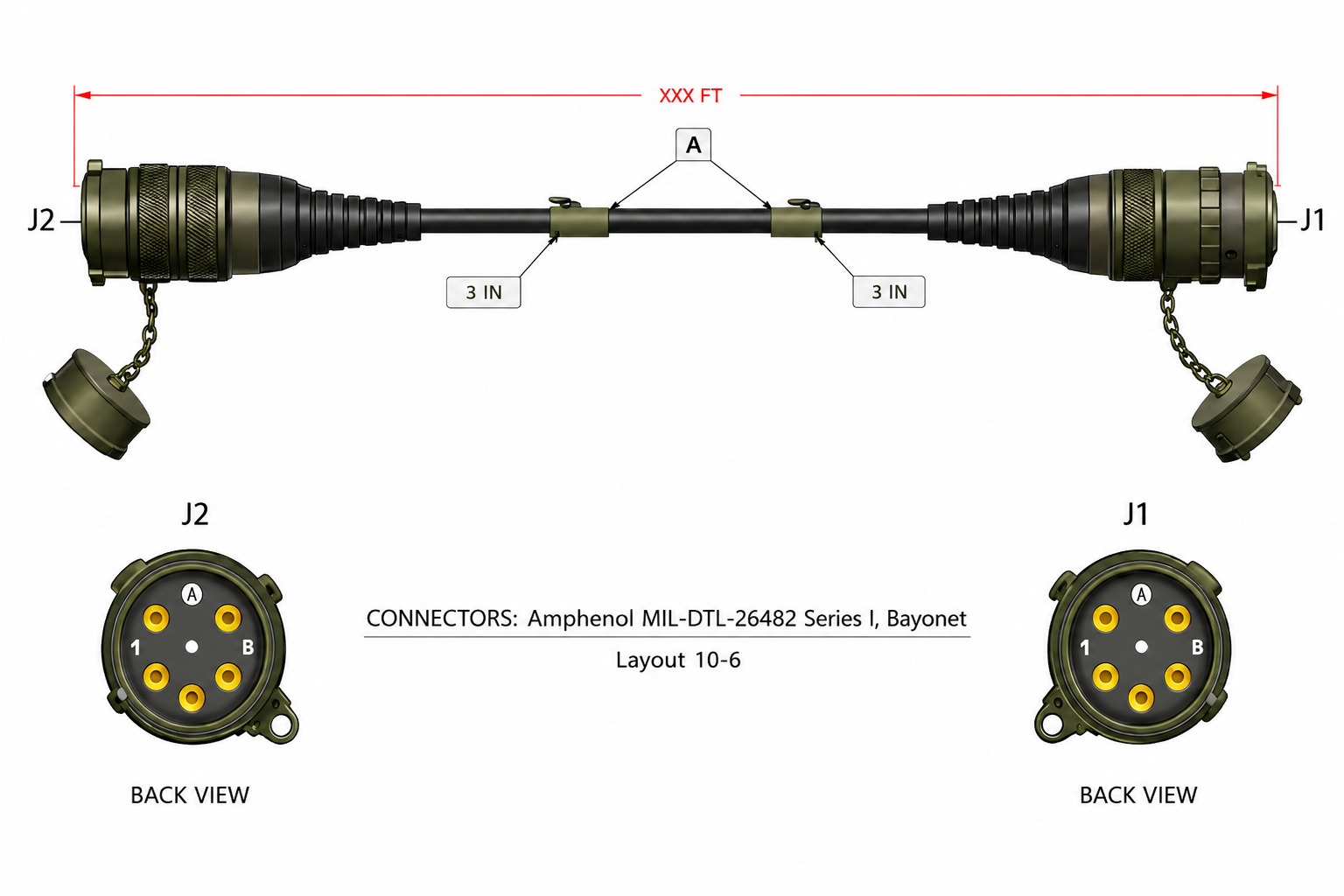
  • MIL-C-26482 Series I, II
  • MIL-C-5015
  • M39012 (RF connectors)
  • Glenair® Series 80 “Mighty Mouse” Connectors

Our solutions are designed for durability, electrical performance, and mechanical resilience in the field. Whether it’s crimp, solder, or mechanically backed connections, we deliver reliable assemblies that meet or exceed military specifications.

System-Level Integration & Box Builds

Beyond standalone cables, Xact EMS offers turnkey integration services. Our harnesses and cable assemblies can be installed directly into:

  • Environmental enclosures
  • Mission equipment panels
  • Racks and chassis
  • Complete system-level box builds

This full-service capability simplifies supply chains and ensures consistent performance across all levels of your system architecture.

Proven in Mission-Critical Defense Applications

Xact EMS products are fielded in a variety of global military platforms, including:

  • Ruggedized tactical military computers
  • Military communications and radio systems
  • C4ISR platforms
  • Unmanned Aerial Vehicles (UAVs)
  • Ground vehicle and chassis-mounted electronics
  • Secure networking environments

Our commitment to quality, traceability, and performance makes Xact EMS a trusted partner in high-reliability defense deployments.

Overmolded Cable Assembly Capabilities

We offer a range of molded solutions using both standard and custom processes, including:

  • Low Pressure Overmolding
  • Hot Melt Molding Technology
  • Slide-On Boots
  • Epoxy/Urethane/RTV Potting & Encapsulation
  • Environmentally Sealed Molded Assemblies

These capabilities enable environmental sealing, vibration dampening, and long-term reliability in extreme conditions.

Advanced Heat Shrink & Strain Relief Expertise

Xact EMS also excels in heat shrink strain relief systems, utilizing a variety of shrinkable materials and form factors to enhance:

  • Mechanical support
  • Sealing integrity
  • Component adaptability

We leverage advanced tooling to maximize throughput and ensure consistent sealing and adhesion.

Your Trusted Partner in Defense Manufacturing

With deep experience, military-grade certifications, and a commitment to quality, Xact EMS is your partner of choice for ruggedized cable assemblies and interconnect solutions tailored to modern defense systems. Let us help engineer your next military-grade solution—built to deploy, built to last.

Built Tough. Sealed Right. Delivered by XACT EMS.

At XACT EMS, we specialize in ruggedized, booted cable assemblies for the most demanding industries — aerospace, defense, rail, oil & gas, and mining. Using industry-standard MIL-DTL-38999 connectors paired with heat-shrink or molded boots from Raychem and HellermannTyton, our assemblies deliver military-grade durability and field-proven sealing performance.

Why Booted Assemblies?

Booted cable assemblies are the first line of defense against:

  • Moisture, dust, fuel, and chemical ingress
  • Vibration and cable fatigue
  • Thermal cycling and UV exposure
  • Mechanical damage at the connector-cable junction

Our boots offer strain relief, environmental sealing, and mechanical support — and are available in straight, 45°, and 90° configurations, stocked and ready for production.

Connector & Boot Compatibility Tables by Industry

Aerospace

MIL-DTL-38999 Connectors

Manufacturer Series Name Common Part Numbers Connector Features Typical Applications
Amphenol D38999 Series III D38999/26WE6SN, D38999/24WB35PN, TV07RW-13-35P, TV07RW-11-99P, D38999/20WE26SN Triple-start threaded coupling, EMI shield termination, high-vibe resistant Avionics, engine sensors, flight control actuators
Glenair Series 80 Mighty Mouse 801-007-07ZNU6-61, 801-009-07ZNU6-09, 801-010-16ZNU6-12, 801-011-16ZNU6-12, 801-002-07ZNU6-9 Ultra-lightweight, quick-disconnect, miniature circular format Instrument clusters, aerospace sensor buses
Souriau 8D Series 8D0A20F35PN, 8D0A17F35SN, 8D0A11F35SN, 8D5M20F35SN, 8D1F13F35PN Composite/aluminum shells, multiple finishes, bayonet/locking options Antenna systems, GPS/INS, control units
ITT Cannon KJA Series KJA0T17F35PA, KJA0F13F35SN, KJA0T19F35PN, KJA0F15F35SN, KJA0T11F35PN QPL-qualified, fully intermateable with Series III, environmental sealing Flight computers, navigation systems
TE / DEUTSCH DTS Series DTS24W15-35SN, DTS26F13-35SN, DTS20F17-99PN, DTS24W11-35SN, DTS20F21-35SN Proven corrosion resistance, bayonet coupling, high-vibration Environmental monitoring, cabin pressure controls

Boot Compatibility

Manufacturer Boot Part Numbers Shape Notes
Raychem (TE) 202K121-25-0, 222A121-25-0, 222A153-25-0, 222D121-25-0 Straight, 90°, 45° Used with Amphenol & Glenair connectors in aerospace bundles
HellermannTyton HBT-90-1, HBT-45-2, HBT-M-2, HBT-3 90°, 45°, Medium, Small Flexible boots for avionics and lightweight harnessing

Defense / Military

MIL-DTL-38999 Connectors

Manufacturer Series Name Common Part Numbers Connector Features Typical Applications
Amphenol D38999 Series I D38999/24WB35PN, D38999/24WD19SN, D38999/24WE6PN, D38999/24WB98PA, D38999/24WD35PN Bayonet coupling, high-speed signal support, EMI gaskets Radios, tactical communication, vehicle wiring
Glenair Series 23 233-108-07ZNU6-9, 233-147-11ZNU6-5, 233-105-07ZNU6-9, 233-148-07ZNU6-9, 233-109-07ZNU6-9 Heavy-duty field-ready shell, environmental grommet seals, 360° EMI shield clamp Soldier-worn gear, battery interconnects, optics
Souriau 8D Series 8D5M20F35SN, 8D0A11F35SN, 8D0J13F35PN, 8D0F17F35SN, 8D0J17F35PN QPL-qualified, dual start thread, corrosion resistant plating Electronic warfare, surveillance, missile guidance
ITT Cannon KJB Series KJB0T17F35PN, KJB0F15F35SN, KJB0T11F35PN, KJB0F13F35PN, KJB0T19F35SN Zinc-nickel plating, robust coupling nut, IP67 sealed Ruggedized field terminals, ground control units
TE / DEUTSCH DTS Series DTS20F19-32SN, DTS24W11-35SN, DTS24W15-99SN, DTS24F13-35PN, DTS20F15-35PN Multiple insert layouts, lightweight composite body, vibration resistance UAV control, rugged handhelds, fire control

Boot Compatibility

Manufacturer Boot Part Numbers Shape Notes
Raychem (TE) 202A111-25-0, 222D131-25-0, 222K121-25-0, 202K142-25-0 Straight, 45°, 90° Designed for MIL-DTL-38999 Series I in military-grade assemblies
HellermannTyton HBT-90-3, HBT-S-2, HBT-XL-2, HBT-45-3 XL, 90°, Slim Ideal for rugged handhelds, soldier electronics

Oil & Gas / Marine

MIL-DTL-38999 Connectors

Manufacturer Series Name Common Part Numbers Connector Features Typical Applications
Amphenol D38999 Series III D38999/20WB98PA, D38999/26WE26SN, TV07RW-13-35P, D38999/24WB35PN, D38999/26WB35SN Salt spray resistance, stainless steel shells, overmold compatible Subsea electronics, ROVs, hydraulic control systems
Glenair Mighty Mouse 801-013-07ZNU6-09, 801-010-07ZNU6-09, 801-011-07ZNU6-09, 801-014-07ZNU6-09, 801-009-07ZNU6-09 Small form factor, rugged elastomeric seals, moisture sealing Downhole tools, pipeline monitoring systems
Souriau 8D Series 8D0J35F61PN, 8D0A13F35PN, 8D1F21F35PN, 8D0F11F35PN, 8D0A17F35SN Shell-to-shell continuity, nickel and RoHS plating, IP68 rated Mud pulse telemetry, MWD systems
ITT Cannon KJA Series KJA0F17F35SN, KJA0F15F35SN, KJA0T13F35SN, KJA0F13F35SN, KJA0T17F35PN Hermetically sealed inserts, thermal shock resistant Offshore platforms, vibration-prone pump interfaces

Boot Compatibility

Manufacturer Boot Part Numbers Shape Notes
Raychem (TE) 222D111-25-0, 222A131-25-0, 222K142-25-0, 222A153-25-0 Straight, 90°, Low-profile Resists oil, saltwater, fuels
HellermannTyton HBT-90-XL, HBT-45-M, HBT-M-XL XL, 90°, Mid Field-mount boots for hydraulic and marine cable systems

Rail / Transportation

Same full-length connector table from molded post.

Boot Compatibility

Manufacturer Boot Part Numbers Shape Notes
Raychem (TE) 222D131-25-0, 222K111-25-0, 222A121-25-0 Straight, 45°, 90° Rail-grade vibration-resistant boots
HellermannTyton HBT-45-2, HBT-M-1, HBT-S-3, HBT-90-3 Medium, Slim, 90° LSZH and halogen-free for compliance with rail standards

Mining & Industrial Equipment

Same full-length connector table from molded post.

Boot Compatibility

Manufacturer Boot Part Numbers Shape Notes
Raychem (TE) 222D153-25-0, 222A131-25-0, 202K142-25-0 Straight, 90°, Extra-flex Designed for rough terrain equipment
HellermannTyton HBT-XL-2, HBT-90-L, HBT-M-XL, HBT-45-L XL, Large Vibration- and impact-resistant for draglines and dozers

XACT EMS – Booted Assembly Experts

XACT EMS is a leading provider of ruggedized, booted cable assemblies built to mil-spec standards. We carry a deep inventory of Raychem and HellermannTyton boots and have in-house tooling to handle any shape or layout — no tooling delays.

Highlights:

  • 25+ years of mil-spec cable assembly experience
  • Inventory of heat shrink & molded boots in 90°, 45°, and straight styles
  • In-house molding, assembly, testing, and machining
  • Manufacturing in Houston, TX 🇺🇸 and Calgary, AB 🇨🇦
  • ITAR, CGP, JPC, NIST, CMMC Level 2, and AS:9100 certified